The case for Potomac Made
The research came first. Now we start making.
Potomac Made brings craft, creativity, and community to the Route 1 corridor. We're starting with a new holiday tradition in Potomac Shores, then hands-on workshops in 2027 that bring together local makers, veterans, military families, and young people.
Before asking anyone for support, we did the homework. Below is what 813 Potomac Shores households asked for, what Prince William County's own market study found, who stands to benefit most, and a plan that grows only when the demand and the money are there.
Founding Fund · Step 1, Holiday Market$5,050 of $51,500 raised, as of October 28, 2026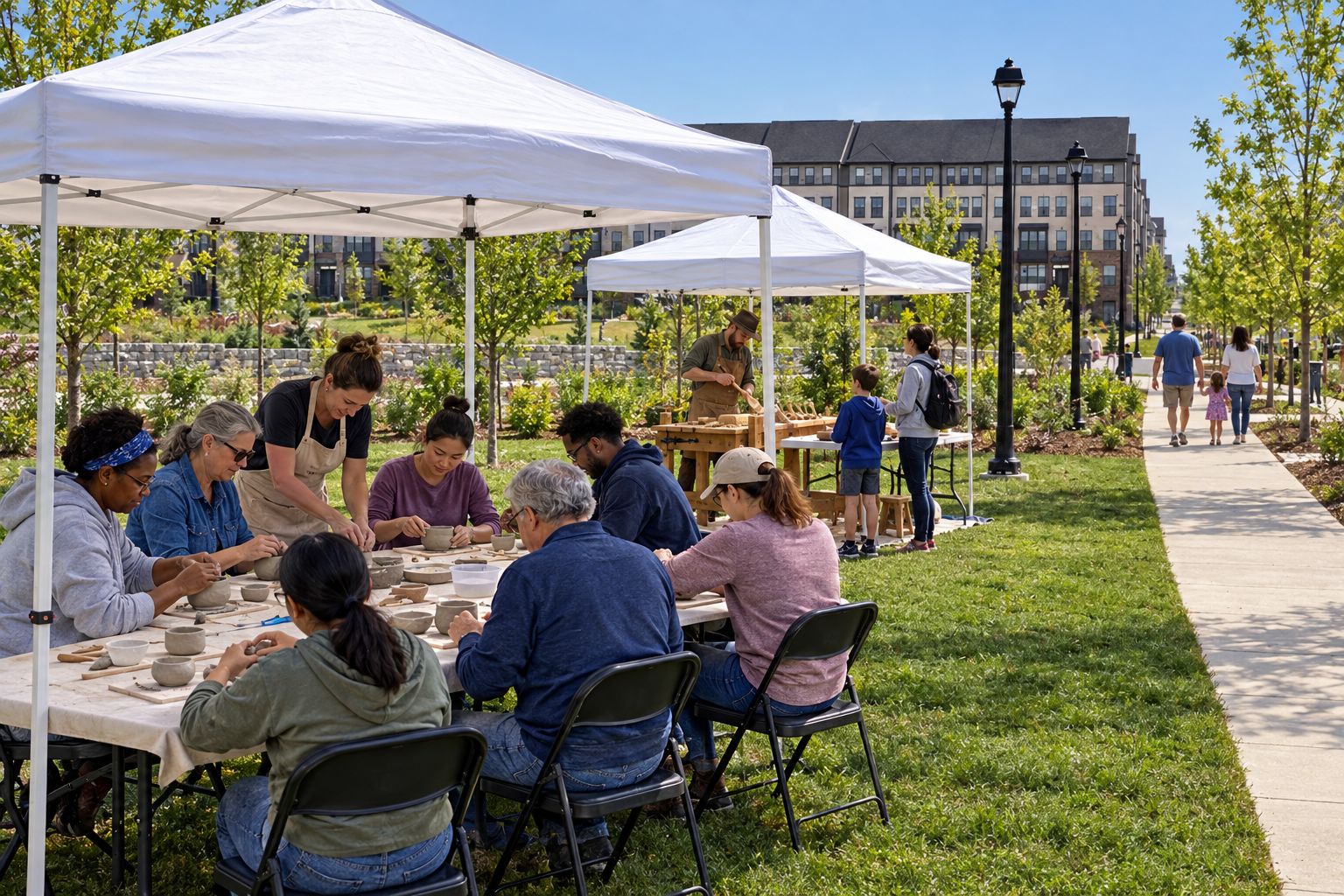
2027 at a glance
- 5Park Days with free demos and Try Me classes
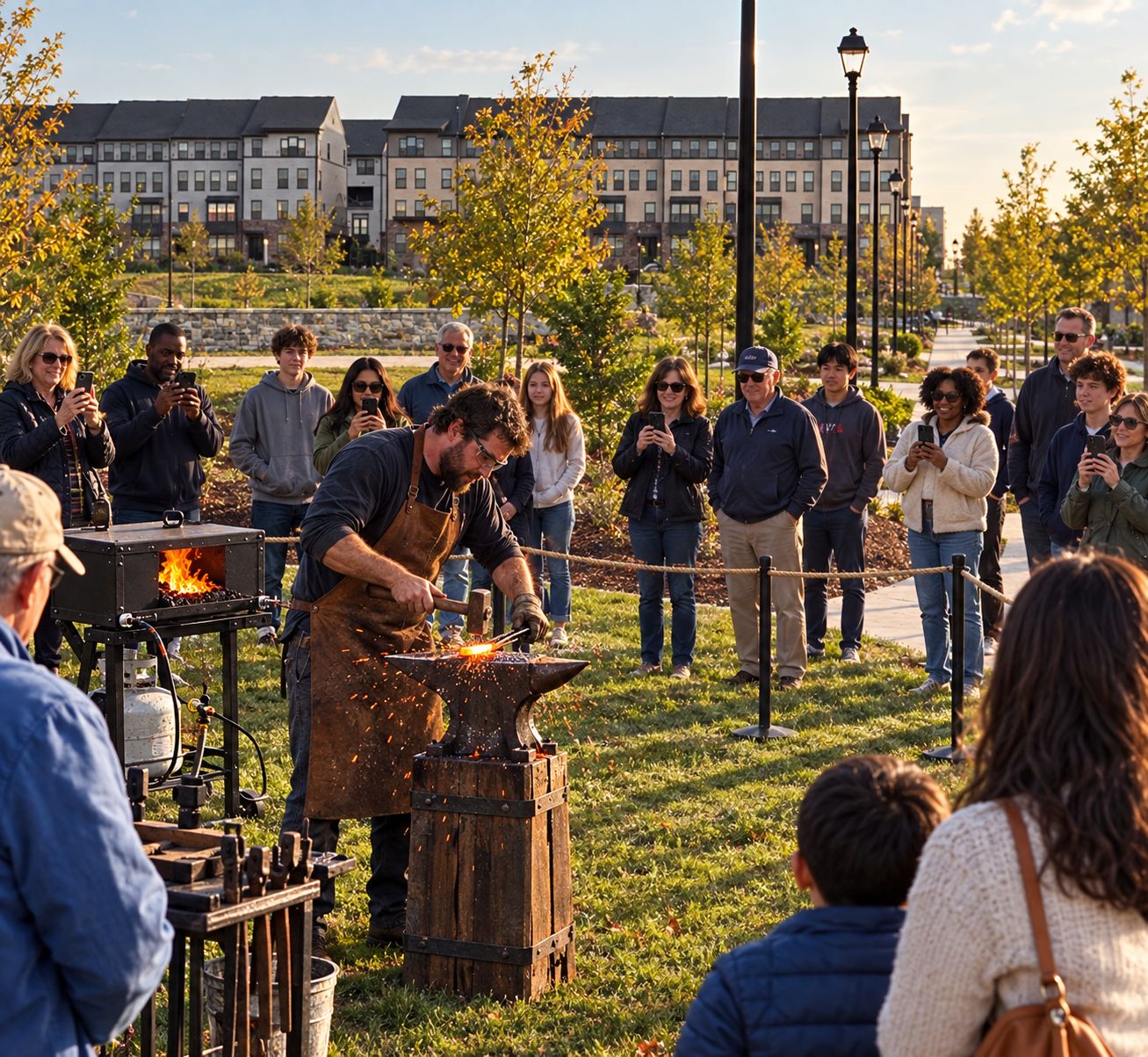
- 1four-week Intro to Glassblowing series with a mobile hot shop
- 3four-week Intro Series: leather, stained glass, ceramics
- ~166class seats, about 40% planned as scholarships
What the neighborhood asked for
Residents want a town center with local character and a reason to gather.
In 2026, the Potomac Shores Town Center Committee surveyed the community. 813 households responded, nearly a third of all homes. Their answers point to the kind of community programming Potomac Made can offer alongside the Town Center as it develops.
Source: Potomac Shores Town Center Committee, 2026 Community Survey, 813 of about 2,550 households (31.9%). The survey measured what residents want from the Town Center. It did not ask about craft classes. We're testing that directly through our own community survey. The 2027 workshops are a pilot. Before we expand, they'll show whether people sign up, what they can afford to pay, whether they attend, and whether they come back for more.
What the County's study found
A regional opportunity: more reasons for people to gather, visit, and return.
In April 2025, Prince William County commissioned a market study of the Fettler Park area next to Potomac Shores. We read its finding as a regional economic-development opportunity, one that grows as new homes, retail, and transit arrive. Recurring markets, workshops, and demonstrations are one way a nonprofit can contribute.
"Commercial tenant interest has been challenged at nearby Potomac Shores. There is a need for additional foot traffic in the area to help drive commercial development."
Fettler Park Area Market Study, prepared for the Prince William County Department of Economic Development, April 2025
- Residents already travel for craft and gifts.People living in the study area made 188,720 trips to hobby, gift, and craft stores outside their area, according to the study's visitor data. That shows spending already leaving the area. It doesn't measure demand for classes on its own, so our community survey is asking residents about classes directly.
- A precedent the study points to.The study profiles the Carmel Arts and Design District in Indiana, which pairs galleries and arts classes with festivals and a holiday market, and drew 3.8 million visits in 2023. It's a model for what this kind of district can become, not a forecast for Potomac Shores.
- The County is planning for it now.The Fettler Park Small Area Plan, started in February 2026, aims to coordinate placemaking and the activation of public and private spaces beside Potomac Shores.
- Our contribution: a reason to come back.Markets, live demonstrations, and multi-week classes are designed to bring people to Central Park and the Town Center on a regular schedule, not once a year.
- Built for the businesses around it.We expect people who come for a class or a market to visit the shops and restaurants around them. That's a goal, not a proven result yet, and we'll measure it by asking attendees and nearby businesses after each event. Our vendors are local makers, and our calendar is designed to support the Town Center, not compete with it.
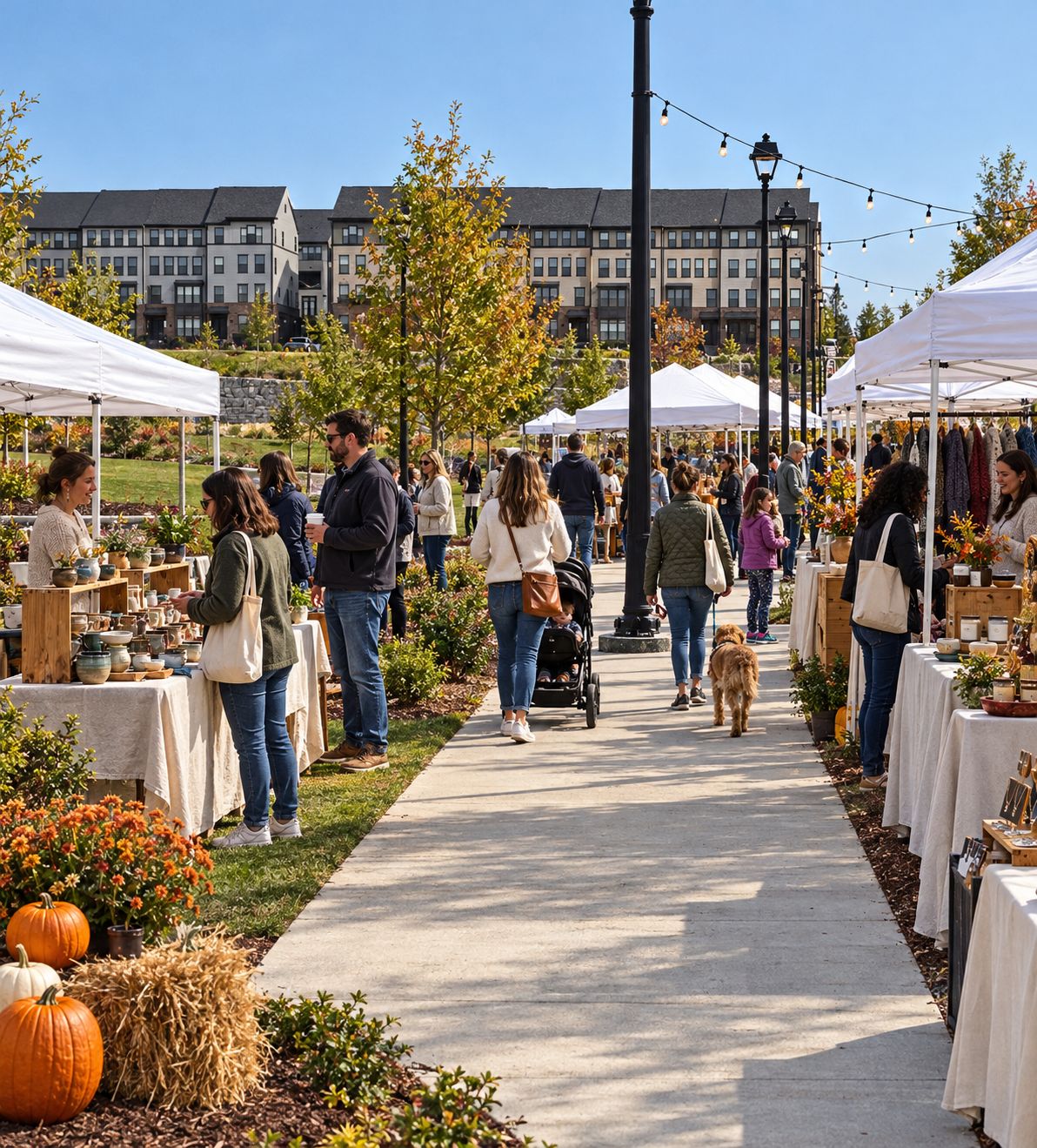
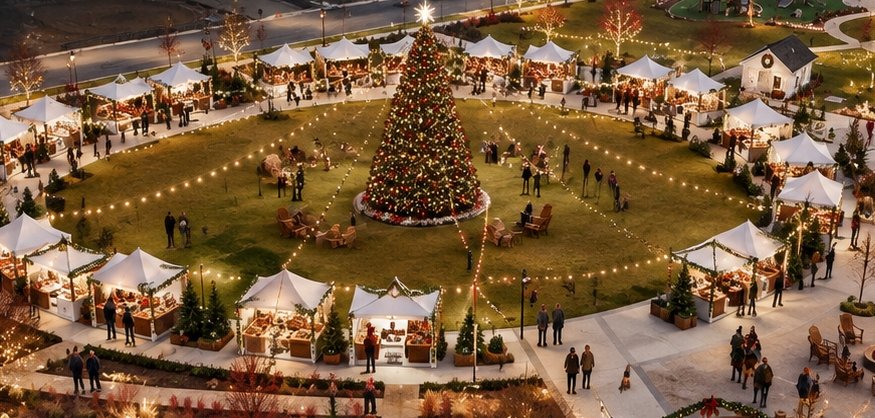
- Visible from day one.The first Holiday Market takes place in Central Park on December 12, 2026, next to the new Waterline apartments and the homes going up around it.
What it means for the Town Center
A reason to come to Central Park, on a schedule.
BREV and its partners are developing the physical place. Potomac Made hopes to complement that investment with independently operated community programming. New homes and apartments are going up around Central Park and the Town Center, and we aim to give the people who live there, and the shops and restaurants below them, a steady calendar of things to do.
Potomac Shores is where the model begins. The Route 1 corridor is who it's meant to serve. The 2027 workshops are open to the wider community, and about 40% of seats are planned as scholarships for veterans, military families, and students from Dumfries, Triangle, and Quantico. The Town Center is the first stage, not the whole audience.
What's already on the way
- Town Center.Biddle Real Estate Ventures (BREV) is building out the Town Center around Central Park.
- Waterline.Hines is opening 365 apartments a block from the future train station, starting spring 2027.
- Station House.The new retail building, leased through KLNB, has an upper-floor restaurant space and room for shops below.
- VRE station.The parking garage is built. The platform is next, with opening estimated for late 2027.
- New homes.Ryan Homes and Stanley Martin are still building, and Kiddie Academy is opening on Captains View Lane.
- Route 1.Dumfries approved a new grocery-anchored center near Potomac Shores Parkway in October 2026. It's widely reported as a possible Publix, but the grocer hasn't been named.
These companies are named for context only. None is a sponsor or partner of Potomac Made, and none has endorsed it. Dates are public estimates and may change.
Help activate the place you're building.
For developers, builders, property managers, and Town Center businesses, Potomac Made offers something hard to create on your own: a steady, published calendar of markets, demonstrations, and classes in Central Park, run by a charity whose mission is the community. Support from the companies shaping the neighborhood helps make that calendar happen sooner and more often.
What we can offer in return is concrete: recurring programming, attendance counts after every event, community engagement, and recognition as a founding supporter. We don't promise higher rents, property values, or sales. Potomac Made remains an independent nonprofit. Partnerships are developed collaboratively, with all programming and financial decisions subject to the organization's mission and board oversight.
Start a partnership conversationSomething to do
Markets, demonstrations, and classes a short walk from home, designed to add to neighborhood life, with Potomac Made doing the planning and staffing.
Regular visits
Events will run on a published calendar, designed to encourage repeat visits and support nearby businesses, the kind of regular activity the County study points to. We'll track attendance to see whether it works.
A story to tell
Supporters can share our calendar with their customers, families, and neighbors, and point to the market and classes happening nearby.
Founding partner
Partners who give now are recognized at events, online, and in the Founding 100 as the people who helped start it.
Who it serves
A corridor full of people who should be making things.
Potomac Shores families help fund the work. Paid classes and donations are meant to fund scholarship seats for veterans, military families, and students along Route 1, as funding allows.
Veteran figures are 2024 American Community Survey 5-year estimates of veterans as a share of the civilian population 18 and over, the same measure used for the Virginia rate, via Census Reporter. The ~6,000 total adds the estimated veterans in ZIP codes 22026 (1,676), 22172 (1,426), 22134 (323), and 22025 (2,599). The school figure is the Virginia Department of Education's free and reduced-price meal eligibility rate for 2024–25. It is a measure of eligibility, not a poverty rate. The Triangle Small Area Plan, adopted by the County in 2021, also found the area "lacks a sense of place."
How it works
Four stages, from first class to paid instructor.
Most programs stop at the class. Potomac Made carries people from curiosity to a craft they can practice, sell, and eventually teach. It's a planned path, and not everyone will take every step. Beginner workshops and markets come first. Open studio time needs a shop, which is Phase 2. In 2027, glass and forging appear only as short, supervised sessions with insured instructors and mobile equipment. Full glass and metal studios need specialized space, so they come later.
Learn
Multi-week beginner workshops with a skilled maker, in small groups.
Make
Open studio time to practice and finish real projects.
Sell
Pricing, photography, and a booth at our markets, side by side with established makers.
Teach
Experienced makers are paid to lead the next class, and the cycle continues.
The plan
Programs before buildings. Each step has to earn the next.
We won't sign a lease or build anything until the community has shown up. Every phase has a gate it must pass first. Before committing to a lease or any capital project, the board will adopt and publish numerical thresholds for paid enrollment, repeat attendance, scholarship use, instructor retention, participant satisfaction, and cost per participant, based on what Phase 1 actually shows.
Holiday Market
Our first public event, in Potomac Shores Central Park. Market equipment is purchased once and reused every year.
Funded by: the first $51,500 of the Founding Fund.
Art in the Park
Four-week beginner workshops outdoors and in partner spaces, free live demonstrations, youth maker camps, and small cohorts for veterans and military families. No facility needed.
Gate to Phase 2: classes that fill, a waitlist, instructors who return, and a funding base to lease space.
A first shop
A leased teaching shop for open studio time, recurring markets, and our first paid staff.
Gate to Phase 3: sustained demand, healthy finances, and community partners committed to a permanent home.
Art on the Potomac
A permanent home with studios, a gallery, and in time a glass and metal hot shop. Only if earned, and only on a site offered by a willing property owner or partner.
Commitment: no construction debt. We build what we can pay for.
We fund scholarship seats for veterans, military families, and students before we spend on space.
Growth is paced by what the community supports, not by borrowing.
What we raise, what we spend, and how many people we serve, every year.
Years are targets, not commitments. Each phase starts only when its gate is met, so the pace may be slower or faster.
What we've put in motion
From research to a first public event.
We don't have a track record yet. Phase 1 exists to build one. Our immediate priority is a well-run first market. We'll document how it goes and use the results to shape our first classes in 2027.
Nonprofit established
Recognized by the IRS as a 501(c)(3) public charity, effective September 24, 2026.
Presenting Sponsor and first supporters
Twins Selling Real Estate & Associates is the Holiday Market's Presenting Sponsor, joined by local businesses and families. $5,050 raised as of October 28.
Market planned
Date, hours, and site set: Saturday, December 12, 12 PM to 8 PM, Potomac Shores Central Park. Equipment list and budget complete.
Vendor recruitment
The market is planned for 45 booths of resident makers and small businesses. They include potters, bakers, candle makers, knitters, jewelers, and paper artists. Applications close October 30, and selected vendors hear back by November 5.
Class demand survey
Residents are telling us which crafts, times, and places they want for Art in the Park in 2027.
Sponsors confirmed, market held, results published
Holiday Market sponsors confirm by November 5 for signage and promotion. The market runs December 12. Afterward we'll publish photos, attendance, vendor results, and spending.
Then: plan the 2027 Art in the Park season.
Your support. Our accountability.
Modest commitments, clear rules, and a public report.
Our long-term vision is ambitious, but our immediate commitments are deliberately small: deliver the December 12 market well, document it, and use what we learn to plan 2027. Here's who's leading it, and how the money is handled in the meantime.
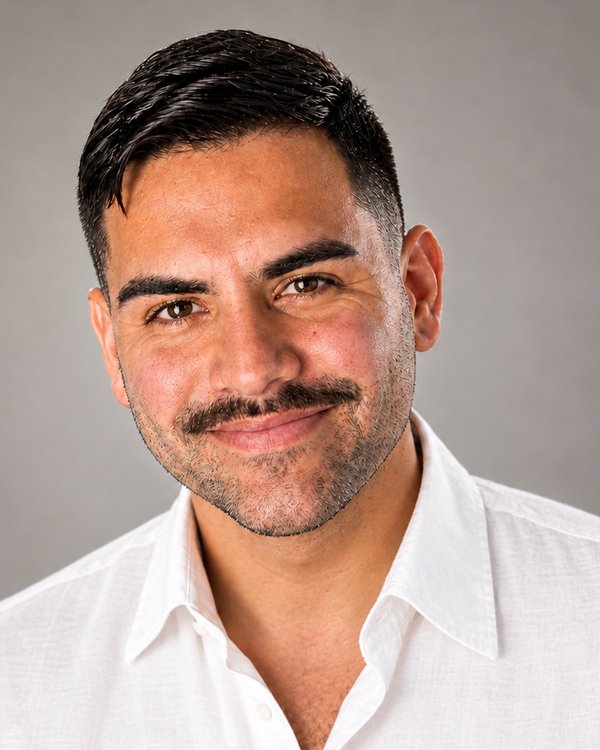
Derek Gebelhardt
Founder & President
A Potomac Shores maker and small business owner who serves on active duty in the U.S. Space Force. His research into the planned Town Center led him to found Potomac Made.
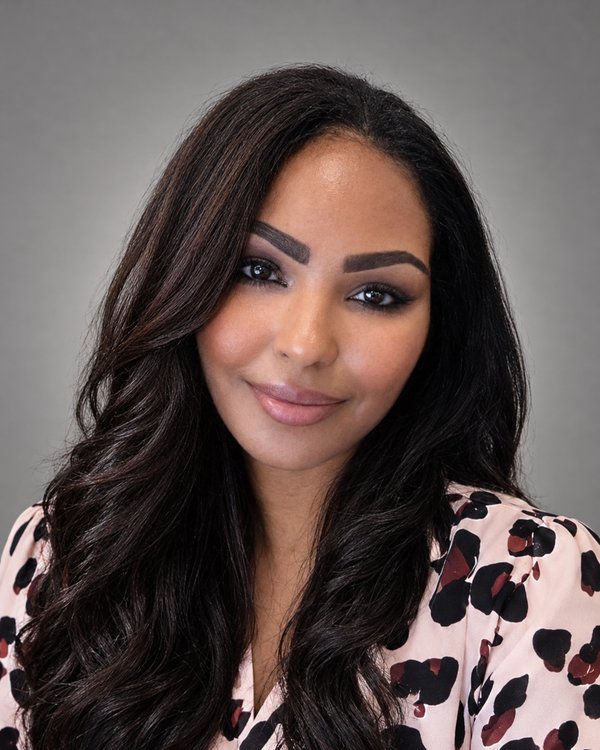
Tresha Armstrong
Director of STEAM Programs & Secretary
A systems engineer turned entrepreneur with an online design community of 500,000+ who leads our youth STEAM programs.
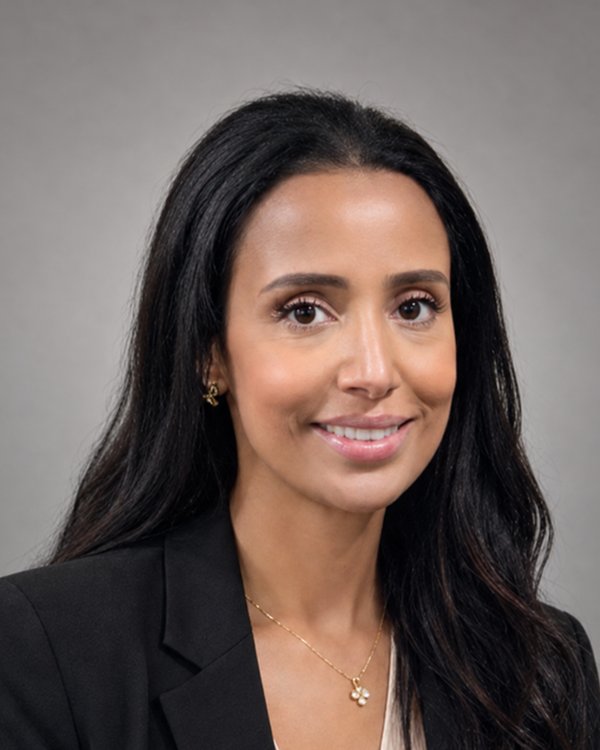
Mehad “Mimi” Bhatti
Director of Community Outreach & Treasurer
A Registered Dental Hygienist of 15+ years and local business co-owner who leads our partnerships, volunteers, and community outreach.
- GovernancePotomac Made is governed by a board of directors under bylaws adopted in September 2026. Founder Derek Gebelhardt serves as President, Tresha Armstrong serves as a Director and Secretary, and Mehad “Mimi” Bhatti serves as a Director and Treasurer. We'll list additional directors as they're seated. Meet our leadership.
- How gifts are receivedGifts are made through Zeffy, which emails a tax receipt automatically. By board resolution, all funds are deposited only in accounts held in Potomac Made's name.
- How spending is approvedUnder our bylaws, every payment must be authorized by the Treasurer, and the organization keeps accounting records and minutes. Potomac Made may not make loans to any director or officer.
- Conflicts of interestOur directors follow a written conflict of interest policy and step out of any decision involving their own interests.
- If we raise less than the goalWe buy only what we've already raised for, in order of need, and we don't take on debt. Base event costs for 2026 are already covered in our operating budget.
- ReportingAfter the market, we'll publish a recap covering attendance, vendors, funds raised, and spending by category, including how directed gifts were used. We'll also file the required annual IRS return. Our bylaws, conflict of interest policy, and 2026 budget are available on request at hello@potomacmade.org.
Where the money goes
$75,000, in two steps.
All gifts go into one Founding Fund. The first $51,500 buys the Central Park community tree and equipment Potomac Made owns and uses again at every market, workshop, and community event. The remaining $23,500 funds the first season of classes, based on a line-item estimate. You can give to the whole fund, or direct your gift to either part. Undirected gifts go to Step 1 first, then Step 2. A gift directed to creative education is held for classes, instructors, materials, and scholarship seats, even if the market equipment goal hasn't been reached. It is never used for the tree, lights, or booths.
Raised so far
$5,050 raised toward $51,500 for the Holiday Market, as of October 28, 2026
The December 12 market doesn't depend on reaching $51,500. Base event costs for 2026 are already covered in our operating budget. Equipment is bought in order of need as gifts come in. The tree comes first, along with power and safety supplies, because it's the heart of the market. Lighting and greenery come next, then matching booth equipment. Vendors bring their own canopies this year. Anything not funded this year carries forward to 2027.
How the numbers fit together
- $51,500, Step 1.A one-time equipment purchase. It isn't part of any year's operating budget.
- $23,500, Step 2.The 2027 class season. It's part of the $61,600 estimated 2027 budget, not added on top of it.
- The rest of 2027, about $38,100.Public events, insurance, storage, permits, and filings, paid for by fees, sponsors, grants, and donors (see how).
Step 1 · $51,500 · Community events and reusable equipment
- 45 maker booths: canopy, sidewalls, table, chairs, and safety gear ($500 each)
- $22,500
- Central Park community tree: 18-foot commercial pre-lit Christmas tree, the market's centerpiece, stored and reused every year
- $14,000
- String lights, welcome archway, and lamp post wreaths
- $3,500
- Garland and evergreens for all 45 booths
- $2,700
- Ornament package, matching tree topper, outdoor cords, and stakes
- $3,000
- Power cords, cable covers, and setup supplies
- $1,200
- Contingency: sales tax on equipment, canopy weights, and price changes
- $4,600
- Total
- $51,500
Step 1 is equipment we keep and reuse, though some garland and greenery may need replacing each year. The tree and ornament figures are based on a vendor quote. The other lines are planning estimates, and actual costs will depend on vendor pricing. Insurance, supplies, and other 2026 event costs are covered separately in our operating budget, funded by our founder.
Why the tree is in the Founding Fund
Residents told us the tree is what makes it a Christmas market, and it's the picture people will share. Instead of renting decorations every year, the plan is a Central Park community tree: a commercial pre-lit tree built for repeat outdoor use, stored and set up every year. It carries a 7-season warranty on the frame and branches. Over seven seasons, the tree and its ornament package work out to about $2,400 a year before setup and storage. We'll track its real cost per year. One sponsor or several can underwrite it through the Signature Christmas Tree Sponsorship, so tree gifts are kept separate from gifts for classes and scholarships.
Step 2 · $23,500 · Creative education and access: Art in the Park, 2027
- Fire-craft classes on 5 Park Days: forging, flameworking, raku (instructor, equipment, and materials)
- $3,500
- Bench and clay class instructors on 5 Park Days
- $3,500
- Bench and clay class materials, about 100 seats
- $3,000
- Intro to Glassblowing with a mobile hot shop: four Saturday sessions, June 5–26, opening with a free public demo
- $4,800
- Three four-week craft Intro Series: leather, stained glass, ceramics
- $3,000
- Tent, table, and chair rentals for 5 Park Days, about $400 each (see note)
- $2,000
- Season insurance
- $1,500
- Registration, signs, and printing
- $800
- Contingency, including rain dates
- $1,400
- Total
- $23,500
About 166 class seats, with scholarship seats for veterans, military families, and students. Instructors are paid to teach. These are planning estimates based on published rates at comparable studios, not quotes. Anything raised beyond Step 1 goes straight to Step 2. The $2,000 is for rentals, not a second equipment purchase. If Step 1's booth equipment is fully funded, Park Days will use it instead, and that $2,000 moves to scholarship seats.
Sponsorships and donations go into the same Founding Fund. To direct a gift to Step 1 or Step 2, note it with your gift or email hello@potomacmade.org, and we'll use it only for that purpose. Education gifts stay reserved for education whether or not Step 1 is fully funded. We'll publish what we raise and spend as programs happen.
The 2027 season
What your gift funds in 2027.
Art in the Park runs from April to October, with classes running side by side in the park so visitors can watch, try a craft, and sign up for more. Two community-wide events bookend the year.
Proposed dates
- Park Day 1: season opener, three classes at once
- Apr 17
- Spring Maker Market and Park Day 2
- May 1
- Park Day 3, Glass Day: free public hot shop demo, then four Saturday glassblowing sessions
- Jun 5–26
- Park Day 4
- Sep 18
- Fall Festival & Oktoberfest, with Park Day 5 and the season's student showcase
- Oct 2
- Christmas Market & Tree Lighting, with a Student Maker Row
- Dec 4
Four-week Intro Series run in spring, early summer, and fall. All dates are proposed. Approval for the December 2026 market doesn't extend to 2027: each 2027 event and class site needs its own approval from the HOA or property owner, and none is secured yet. The Fall Festival and Christmas Market are planned as events for the whole community.
What a gift covers
- One Try Me class for 10 neighbors
- $650
- One fire-craft class: forging, flameworking, or raku
- $700
- One glassblowing student for four weeks
- $800
- One four-week craft Intro Series
- $1,000
- A full Park Day, 26 seats
- $2,000
- The public glass demo and first glass class
- $2,700
- The full Intro to Glassblowing series
- $4,800
Comparable classes at studios in the region sell for about $90 to $225 a seat. Gifts keep our classes affordable and fund scholarship seats. All figures are planning estimates.
What a gift accomplishes
If you give $10,000, here's what happens.
A gift of about $10,000 directed to creative education would fund a full share of the 2027 season. Here's what it pays for, when it happens, and how we'll show you whether it worked.
What it funds
- The full Intro to Glassblowing series: a free public demo, then four Saturday sessions for about 6 students
- $4,800
- Three four-week craft Intro Series (leather, stained glass, ceramics), about 30 seats
- $3,000
- One full Park Day: three Try Me classes at once, 26 seats
- $2,000
- Total, about 62 class seats
- $9,800
Planning estimates based on published rates at comparable studios, not quotes. The remaining $200 goes to the season contingency.
- WhenClasses run April through October 2027. The glass series is planned for four Saturdays, June 5–26, and the Intro Series run in spring, early summer, and fall. Dates are proposed and depend on site approvals.
- Who it servesAbout 40% of seats are planned as scholarship seats for veterans, military families, and students. The rest pay a modest fee.
- How we'll know it workedFor every class, we'll track seats filled, scholarship seats used, attendance at each session, and how many students sign up for another class. Students and nearby businesses will get a short survey. We'll report activities, like seats and attendance, separately from outcomes: how many people keep practicing, start selling, or begin teaching.
- What you'll receiveA written report by November 30, 2027, with those numbers, photos from the classes you funded, and a summary of how directed gifts were spent.
How it's paid for over time
Fees cover part of the cost. Gifts keep it open to everyone.
Classes aren't designed to pay for themselves, and most community arts programs don't. Here's how the pieces are planned to fit together.
Class and booth fees
Full-price seats pay a modest fee (about $35 for a Try Me class and $300 for the glass series). Market makers pay a booth fee. We estimate fees will cover about 18% of 2027 costs.
Paid to teach
Every instructor is paid at local rates for teaching time, prep, and materials. That keeps quality high and makes teaching worth a local maker's time.
Scholarship seats
About 40% of seats are planned as scholarships for veterans, military families, and students, funded by donations and sponsorships, not by raising prices on other students.
Sponsors, donors, and grants
Event sponsors fund the community markets. Individual and monthly donors fund most of the rest. We'll apply for Virginia Commission for the Arts grants as we become eligible.
2027 estimate: about $61,600 in total costs, with about $11,000 from fees, $12,000 from sponsors, $5,000 from grants, and $33,600 from individual donors. These are planning estimates, not a forecast, and we'll update them after the first season.
Programs scale to the money we actually have. We commit to each part of the season only after its funding is in hand. If a grant or sponsorship doesn't come through, we run fewer Park Days or Intro Series rather than spend money we don't have, the same discipline we apply to the long-term plan.
How you can help
Be part of the first chapter.
Founding supporters shape what this becomes. Businesses, organizations, and neighbors who give now are recognized as founding supporters of the programming that gives Potomac Shores and the Route 1 corridor their character.
Sponsor the Holiday Market
Recognition at the event and online, and a place in the Founding 100. Community Partner is $2,000, and the Signature Christmas Tree is $17,000, alone or shared. Confirm by November 5 to be recognized on market signage and promotions. 2027 programs and multi-year partnerships are discussed on an ongoing basis.
Fund the first class season
Gifts in this range go to Art in the Park in 2027: artisan pay, materials, tool kits, and scholarship seats. $650 funds a class for 10 neighbors, and $1,000 funds a four-week Intro Series. See the 2027 season.
Give to the Founding Fund
One fund, two steps: the Holiday Market first, then Art in the Park. Every gift is tax-deductible to the extent allowed by law.
Founding Institutional Partners
For companies, developers, financial institutions, and foundations that want to support Potomac Made over more than one season. We'll build the partnership around your priorities, whether that's the Town Center calendar, scholarship seats for veterans and military families, or youth programs, and send you a written report on attendance, scholarships, and spending each year. We don't publish a tier schedule for these, and there's no deadline: the November 5 date applies only to Holiday Market signage. Email us to start the conversation.
A gift of any amount to the Founding Fund. Give $100 or more and you join the Founding 100, listed by name on our website.
A business gift at a listed level, with the recognition shown for that level: logo placement, signage, and event acknowledgment. See sponsor levels.
Both are charitable contributions to the same Founding Fund. If a sponsor receives goods, services, or advertising in return, the deductible amount may be reduced.
For businesses and organizations
- What you fund
- Reusable Holiday Market equipment now (the tree, lighting, and booths), then the 2027 Art in the Park class season. You can direct your gift to either one, and we use it only for that purpose.
- Who benefits
- Community events in Central Park, a market for local makers, and hands-on workshops in 2027 open to the wider community, with scholarship seats for veterans, military families, and students.
- How you're recognized
- Community Partners ($2,000) receive featured logo placement on our website and sponsor signage, recognition in select promotional materials, acknowledgment at the event, and a place in the Founding 100. Larger or multi-year partnerships are arranged by email.
- What we report
- After the market, every sponsor receives our recap: attendance, vendor results, funds raised, and spending by category, including how directed gifts were used. Our IRS letter, bylaws, conflict of interest policy, and budget are available on request.
Sources
- Potomac Shores Town Center Committee, 2026 Community Survey (813 responses). Available to residents on the Potomac Shores resident portal. We cite top-line results only.
- Hunden Partners, Fettler Park Area Market Study, prepared for the Prince William County Department of Economic Development, April 17, 2025. Quotation from the market feedback section; visitor data from Placer.ai; Carmel case study from the comparable districts section.
- Prince William County, Fettler Park Small Area Plan.
- Prince William County, Triangle Small Area Plan, adopted 2021.
- U.S. Census Bureau, American Community Survey 2024 5-year estimates, via Census Reporter: 22172, 22026, 22134, 22025, Virginia.
- Virginia Department of Education, School Quality Profile: Potomac High, free and reduced meal eligibility, 2024–25.
- Internal Revenue Service, determination letter for Potomac Made, 2026.
- Neighborhood development: Multifamily Dive (Hines, BREV, home builders); Waterline at Potomac Shores; Potomac Shores, Station House and KLNB leasing; Potomac Local, VRE station; Kiddie Academy of Potomac Shores; WTOP, Dumfries grocery approval.